-
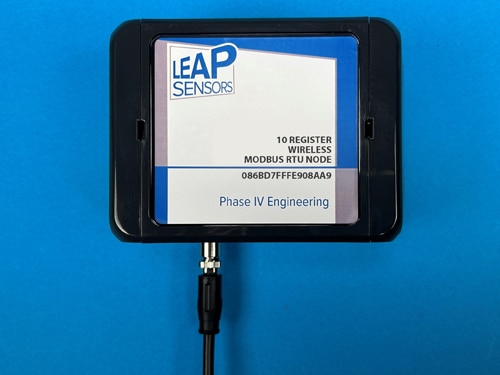 Wireless transceiver node with an RS485 Modbus RTU interface can read up to 10 Modbus registers to track valuable machine monitoring data. Can be used with almost any Modbus RTU sensor and communication device. Contact us to discuss best options for your application. Connect the transceiver node to a variable frequency drive (VFD) to collect data such as electric current draw, voltage levels, RPM, temperatures, and error conditions. Ideal for predictive maintenance or automated process auditing. Due to the high-power consumption of the Modbus RTU interface, this transceiver node typically uses a external power source to power the node. Battery power is an option if data sampling and transmitting is done every few hours. Part of the breakthrough Leap Sensors® system. Build your quote here:
 -
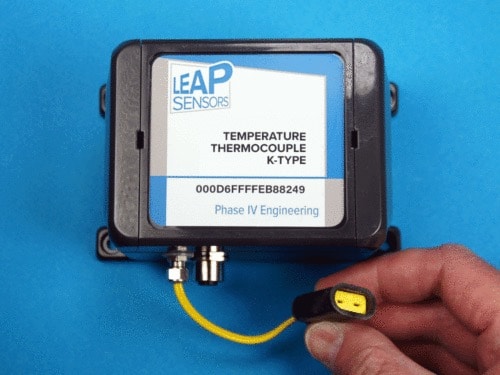 This Leap wireless sensor has two standard mini thermocouple connectors that can connect to any K-type thermocouple. Because thermocouples can be used over a wide temperature range and thermocouples come in a huge range of probe types, this sensor addresses many harsh industrial applications. Part of the breakthrough Leap Sensors® system. Build your quote here:
 -
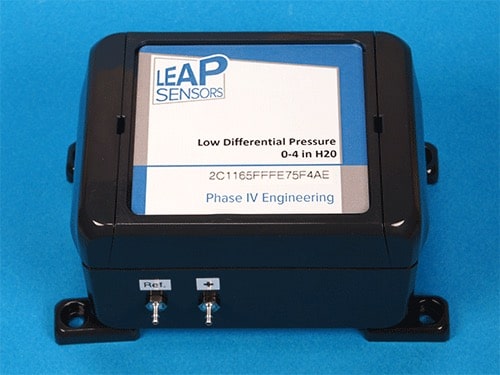 This very unique wireless sensor works by comparing the readings from one device node to another user-selected device node - then reporting the local pressure, local temperature - then differential pressure and temperature as compared to a user selected sensor. For example, sensor A is located outside at ambient temperature and pressure. Sensor B is located in a clean room under positive pressure and Sensor C is located in a different part of the cleanroom under a higher positive pressure. Sensor B could be configured to report its pressure and temperature and the differential pressure between Sensor B and Sensor A. (See the screen shot). Sensor C could be configured to report its pressure and temperature and the differential pressure and temperature between sensor C and sensor B. Sensor readings are reported in PSIA. Leverage the Leap SensorManager software to send text, email, or telephone alerts when a pressure, temperature, or delta-pressure or delta-temperature threshold is exceeded. Integrate the data from the differential pressure sensors into other software using our web-based API, Modbus, DNP3, or other data interface protocols. The wireless sensor can be configured with pressure sensors that have different ranges, resolutions, and accuracies for different applications. See the specification below for more information on the different options. Pressure sensors can be configured to specific applications. The pressure and temperature sensors in the photos have the pressure and temperature sensor sealed inside the enclosure with a pressure port in the back of the enclosure. Part of the breakthrough Leap Sensors® system. Build your quote here:
 -
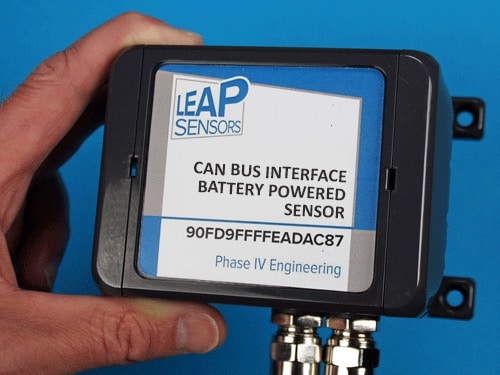 The Leap wireless transceiver can integrate with most sensors with a CAN bus interface. The sensor is powered by the Leap Sensor device battery with a power supply that can be specified from 3.6V to 24 volts. No external power source is needed. Contact us to let us help you make your selected CAN bus sensor wireless. Part of the breakthrough Leap Sensors® system. Contact us with the details of the CAN sensor that you want to integrate with the Leap wireless sensor system. Build your quote here:
 -
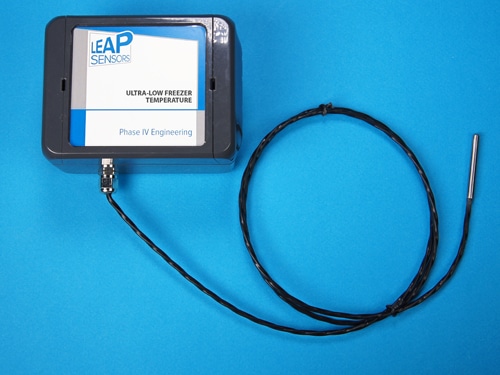 Ultra-low temperature (ULT) sensor system gives continuous remote monitoring of the internal temperature of ultra-low temperature (ULT) freezers. Set alerts via phone, text, or email to know about issues even if you're not on-site. Streamline auditing processes. Ideal for temperature-critical applications such as laboratories, medical facilities, vaccine storage, medicine storage. This remote monitoring system for ULT freezers is designed with key features exclusive to Leap Sensors:
- High accuracy RTD sensing at ultra low temperatures - as low as -196ºC (-320ºF).
- Temperature probe is verified and calibrated at 3 points: -60ºC, -40ºC, and +5ºC (-76ºF, -40ºF, and +41ºF)
- Optional industrial door-open sensor helps troubleshoot temperature alerts, as well as tracking each time the door is opened. Time that door is left open is reported - and alarms can be set on excessive door-open time.
- Optional wall transformer powers the sensor and also alerts power outages. On-board battery backup assures sensor node operation during power outages.
-
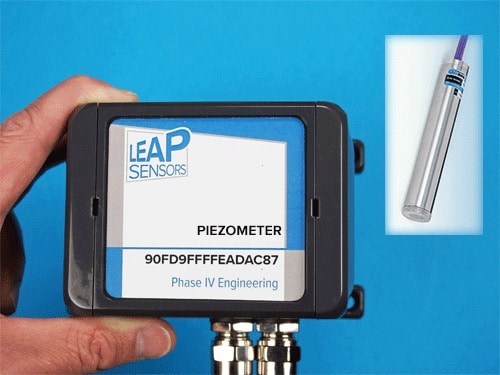 Sensor transceiver node designed to integrate with a wide range of piezometers that have a mV/V, 4-20 mA, or 0-5 V or 0-12V output. Wireless piezometers are typically used for monitoring fluid pressures or pore water pressure in embankments, boreholes, standpipes, reservoirs, and tanks. Maximum pressure ranges from 100 kPa to 6 MPa. Contact us to find the best piezometer configuration for your specific application. Part of the breakthrough Leap Sensors® system. Build your quote here:
 -
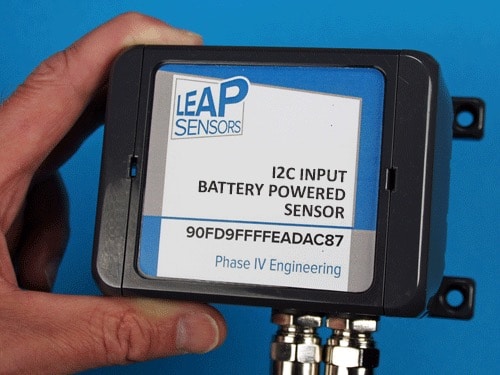 The Leap wireless pressure transceiver can integrate with every type of sensor with an I2C output. The sensor is powered by the Leap Sensor device battery with a power supply that can be specified from 3.6V to 24 volts. No external power source is needed. Contact us to let us help you make your selected I2C sensor wireless. Part of the breakthrough Leap Sensors® system. Contact us with the details of the I2C that you want to attach to the Leap Transceiver Node. Build your quote here:
 -
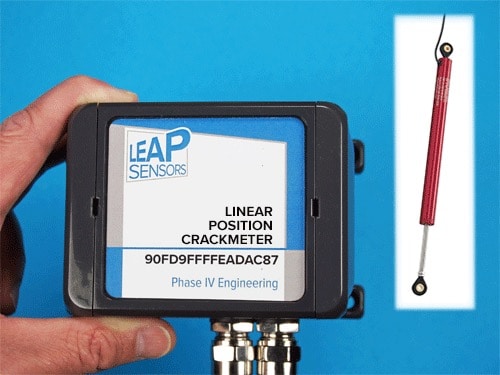 Sensor transceiver node designed to integrate with a wide range of linear position sensors and crack monitors with common outputs such as 0-5V, 4-20 mA, and RS485. The crack monitor is powered from the battery in the Leap transceiver node. When combined with a wireless transmitter, these sensors are very effective at monitoring changes in cracks or other movement over time in remote locations. Part of the breakthrough Leap Sensors® system. The linear sensor that meets your specific requirements will be integrated and tested with this device node. Contact us to find the best linear position configuration for your specific application. This external linear crack sensor is not included in this price but will be included in a final quote. Build your quote here:
 -
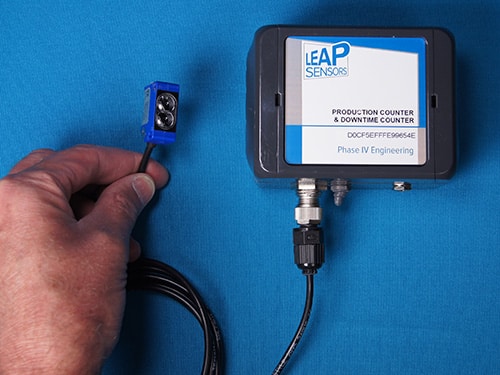 Improve factory visibility and efficiency with a wireless production counter sensor designed for real-time production tracking and production monitoring. This industrial counting sensor counts each unit moving along a conveyor or production line that passes by using a photo eye or proximity sensor, functioning as a reliable product counter and production counter for manufacturing operations. It uses our proprietary edge logic to record outputs, providing accurate production data without manual input.
- Calculates the time between each product's pass to identify when downtime occurs and its duration.
- Displays current state of the line, up or down.
- Real-time manufacturing tracking triggers text, email, and telephone alerts when the downtime exceeds certain user-set limits.
- Easy installation – 5 minutes to set up.
- Count-reset button on top of the enclosure resets the count at the end of a shift.
- Functions as a production monitoring system, tracking 10 manufacturing KPIs, including: machine utilization, product counts, downtime events, OEE, stop counts, total downtime, and total active time.
-
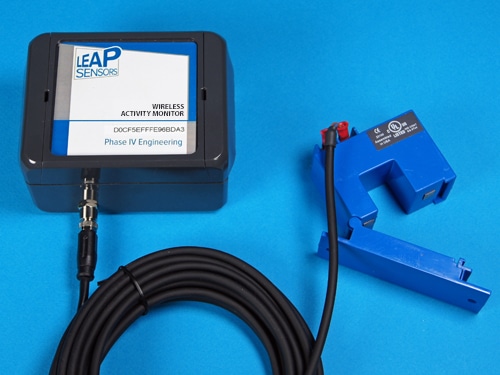 Reduce manufacturing downtime and gain real-time visibility into production performance with this wireless machine downtime monitoring system. This groundbreaking sensor delivers accurate machine downtime tracking, uptime measurement, and automated alerts to help teams respond faster, improve equipment utilization, and drive measurable downtime reduction.
- Also monitors seven manufacturing KPIs, including: machine utilization, current state (up or down), downtime events, OEE, stop counts, total downtime, and total active time.
- Simple, streamlined installation; software detects the sensor automatically.
- Reset count at the end of a shift or configure triggers to reset automatically.
- Display the data on your production floor using our custom dashboard option.
- Ideal for monitoring machine utilization and ROI on large capital investments.
-
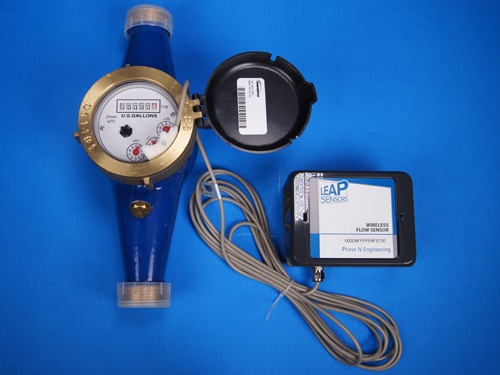 This groundbreaking sensor node integrates a discrete pulse flow meter to count units of flow (i.e. gallons, liters, etc) as liquid flows through a line. Unit can also be used as an incremental encoder for monitoring machinery speeds and total output. The transceiver node times individual pulses and their accumulated counts as they occur. It then uses edge computing to determine current flow rates and total volume of liquid passing through the meter. The edge logic also identifies when flow has stopped, duration of flow events, and duration of stop events. For ease of analysis, the node calculates both instantaneous rate of flow and its duration since the last sensor data reset, as well as a value to indicate if flow is currently occurring.
- Monitors 11 different output variables, such as pulses, flow rate, total pulses, total volume, etc. See specifications for more details.
- Transceiver node is powered by a 120V wall transformer that plugs into a jack on the bottom of the enclosure (no battery powered options available.) Data is transmitted wirelessly via a gateway to the software.
- Connects to the Leap Wireless Sensor System with a secure 2.4GHz, FCC-certified radio.
- Count-reset button on top of the node enclosure resets the total flow at the end of a measurement period. Users can also set automated resets based on time of day.
-
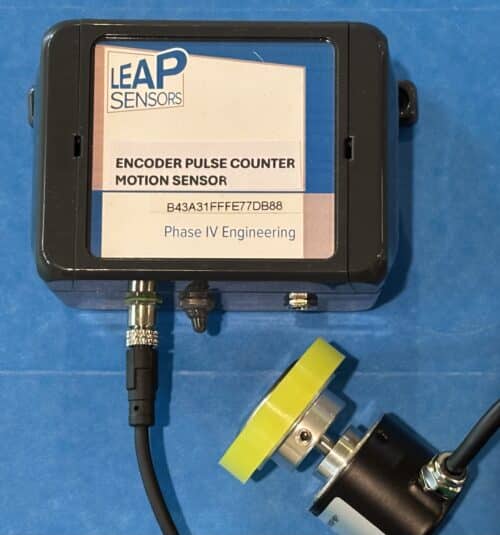 This wireless pulse counter sensor allows you to monitor material length, surface velocity, and production on any continuous production line, whether you need seamless PLC integration or a fully standalone wireless solution. The Leap sensor node integrates with virtually any pulse-output encoder, including contact measuring wheels, rotary shaft encoders, and Hall-effect sensors. Data is transmitted wirelessly through a secure 2.4GHz radio to the monitoring software. Edge computing built into the transceiver node calculates speed, distance, and stop/run events in real time, so you get immediate, actionable production data.
- Monitors 11 output variables including instantaneous velocity, total distance, total run time, total stop time, and a live moving/stopped status flag
- Edge computing on the node identifies motion events and stop events automatically, with configurable timeout to define when movement has stopped
- Resets total counts via a button on the enclosure, remotely through the software, or on up to 4 scheduled times per day
- Handles pulse rates up to 1,000 pulses per second — suitable for high-speed production environments
- Ideal for permanent retrofits on legacy equipment or temporary process optimization and acceptance testing
- Up and collecting data in minutes — no wiring infrastructure, no IT integration, no PLC required
Wide variety of probes available. Contact us to learn about options for your specific applications. Part of the breakthrough Leap Sensors® system. Build your quote here:Configured to Your Application